
What California Faith Leaders Saw Inside a Divisive Immigration Facility
-
 February 20, 2026Published In:
Written By: Chandler Marquez, Director of Public Affairs
Guiding communications and outreach initiatives for the Diocese, Chandler is actively engaged in broader Church initiatives at the state and national levels, contributing to conversations on faith, public policy, and the Church’s role in civic life.
California City feels suspended in time — quiet, sparse, almost otherworldly. Passing through the Kern County town calls to mind a cinematic image: a remote outpost on a distant planet. Beyond it stretches an even lonelier road, leading to a correctional facility run by CoreCivic, the largest owner of private, for-profit correctional, detention and residential facilities in the United States.
The U.S. Immigration and Customs Enforcement (ICE) contracts with CoreCivic to detain immigrants at the California City Correctional Facility, which rises from the desert floor, visible for miles.
The closer you get, the more imposing it becomes — massive, stark against the landscape and difficult to ignore.
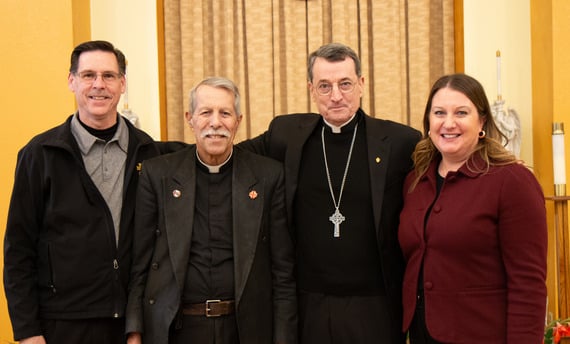
On the morning of Feb. 16, I joined Bishop Joseph Brennan of the Diocese of Fresno and Bishop Brian Nunes of the Archdiocese of Los Angeles as they visited the California City ICE facility. The visit was representative of the California bishops’ initiative emphasizing the importance of pastoral and spiritual care for those detained.
The three of us were a part of a larger delegation that included Father. Kris Sorenson, a pastor in California City, Deacon Joe Lubatti, a chaplain in our Diocese and Kathleen Domingo, the executive director of the California Conference of Catholic Bishops.
Leading up to our visit, we were all aware of the facility’s reputation for very poor conditions. Our visit came just weeks after politicians — including the state attorney general — condemned the environment on multiple counts.
“After inspecting the facility, the California Department of Justice ... has grave concerns about the conditions at the facility and the lack of adequate medical care,” wrote Attorney General Rob Bonta in a letter addressed to the Department of Homeland Security in December.
We passed through the barbed-wired fences and parked near each other. As the clergy gathered their items, I sensed a quiet, shared unease. It was not fear, but the weight of the unknown.
Security was tight, as expected. After entering through a series of gates, entry resembled an airport security checkpoint. Guards managed a busy flow that included our delegation, staff changing shifts and families arriving for visits. Despite the morning rush, guards remained professional and courteous.
Celebrating Mass
The facility chaplain led us down a long corridor into a gymnasium where Mass would be celebrated. The areas of the facility we were permitted to see were clean and orderly. Nothing we witnessed in those spaces caused alarm among our delegation, and staff members remained professional to everyone throughout our visit.
Upon entering the gym, we assisted the bishops in preparing for Mass. Moments later, the detainees filed in unrestrained, orderly and respectfully, forming several lines near the makeshift altar. The bishops decided that the altar felt too far from the congregation and asked the detainees if it could be moved closer, a request which was welcomed.
About 70 men ranging in age from 20 to 50 stood quietly, waiting as the bishops prepared to begin Mass. With extra time before the scheduled start, both bishops and Father Sorenson heard confessions.
This particular moment was profound. About a quarter of the men took turns confessing while the rest stood quietly. After confessions concluded, Mass began when the facility chaplain leaned over to me and mentioned that although only a few of the detainees present spoke English, roughly 90 languages were represented among the group.
It was also explained to me that these men were being held only because they were not in our country legally. Some said they were U.S. citizens who had been caught up in the broader confusion of the nation’s chaotic immigration system.
As Bishop Brennan celebrated Mass, nearly everyone participated, responding to prayers and singing the Mass parts, many in their own languages, some even swaying gently to the melodies.
Belief in human dignity
As much as many of us might wish otherwise, we cannot escape the challenges our nation is facing. Immigration is a ubiquitous topic, but many of us experience it differently. For some, immigration is abstract and lived only through headlines. For others, it can mean detention, forced separation from loved ones and deportation.
Catholics believe in human dignity and accompanying those in need. Those principles carry new weight for me since our experience in California City. Meeting those men, shaking their hands, seeing the fear and frustration in their eyes and sharing faith with them makes the call to uphold human dignity even more urgent.
As Catholic bishops have said, our nation has a responsibility to regulate its borders and promote the common good, and, additionally, everyone has the right to human dignity regardless of nationality, legal status or circumstance. Human dignity and national security do not need to be at conflict.
Reject dehumanizing rhetoric
Our country and our elected leaders must do better. We need tangible results that reflect meaningful and just immigration reform.
Until then, the dignity of our immigrant brothers and sisters needs to remain paramount. No matter where you land on the political spectrum, you have the opportunity to reject dehumanizing rhetoric and focus on the well-being of other humans.
On behalf of the Diocese of Fresno, I thank our clergy and chaplains who accompany those detained, including clergymen and chaplains of other faiths. We hope government entities will continue to allow detainees access to pastoral care and spiritual support, two pivotal principals in restoring and maintaining human dignity for these people.